Ravelynto
Slate Collection
Slate Collection
Couldn't load pickup availability
1. Problem Statement
As Ruby lessons become more detailed, learners often need a stronger way to organize what they already know. They may understand variables, conditions, loops, methods, arrays, and hashes, but still feel uncertain when these concepts need to work together inside a larger script. A first version of a file can become difficult to revise when names, data structures, and program flow are not planned with care. Learners may also need more practice comparing different code arrangements and explaining why one structure reads better than another. Slate Collection addresses this by focusing on planning, structure, review, and practical revision.
2. Solution
Slate Collection presents Ruby learning as a careful building process. Each module introduces a topic, connects it with earlier concepts, and includes a coding task that asks learners to apply the idea in context. The course encourages students to plan before writing, read before changing, and revise after reviewing the output. Examples are designed around small but connected Ruby scripts rather than isolated fragments. This helps learners build skills through organized study, practical repetition, and thoughtful code review.
3. What’s Inside
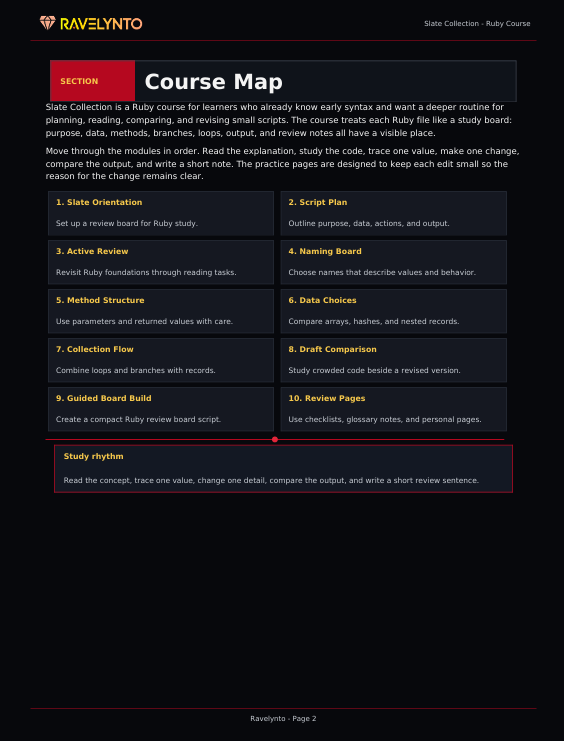
The course begins with a structured review of Ruby foundations. Learners revisit values, variables, expressions, conditions, loops, methods, arrays, and hashes through active reading tasks. Instead of simply reviewing definitions, students study short examples, identify how each line behaves, and explain the role of each part.
A planning module follows. Students learn how to outline a small Ruby script before writing it by identifying the data, actions, conditions, repeated steps, and expected output. This section helps learners approach coding tasks with a clearer structure.
The method-focused module explores parameters, return values, naming, and separation of responsibilities. Students review examples where code feels crowded, then revise them into smaller sections. The course also includes a data module that studies arrays, hashes, and nested information. Learners practice reading grouped values, updating data, looping through collections, and choosing a suitable data shape for a task.
A dedicated revision module asks students to compare two versions of the same script. They study naming choices, duplicated logic, method length, and program flow. The closing activity brings the course topics together in a guided Ruby build, where learners plan, write, review, and refine a compact script.
Each module includes recap notes, vocabulary explanations, coding prompts, reading drills, and reflection questions.
4. Who Is This For?
Slate Collection is intended for learners who have already worked with Ruby basics and want a more detailed study route. It fits students who can write short Ruby examples, but want more practice organizing concepts into complete small scripts.
This course also suits learners who prefer structured materials, practical exercises, and review tasks that focus on reading, planning, and revising code.
5. What You’ll Learn
- Review Ruby foundations through active reading tasks
- Plan small Ruby scripts before writing code
- Identify data, actions, conditions, and output
- Write methods with clear responsibilities
- Use parameters and return values in practical examples
- Work with arrays, hashes, and nested information
- Loop through collections with purpose
- Compare different versions of the same script
- Revise crowded code into clearer sections
- Improve naming choices in Ruby examples
- Complete a guided Ruby build from plan to review
6. 30-Day Refund Terms
Slate Collection is covered by Ravelynto’s 30-day refund terms for paid courses. A refund request may be submitted within 30 days of purchase and will be reviewed according to the refund policy published in the store.
Self-paced learning overview
- 💾 Digital file available after purchase
- 📚 Long-term availability
- 🔐 Secure checkout
- 🛠️ Content updated in 2026
How are Ravelynto courses organized?
How are Ravelynto courses organized?
Each course follows a structured sequence of modules, explanations, examples, review sections, and practical coding tasks. The scope and depth increase across the course collection.
Do I need prior Ruby knowledge?
Do I need prior Ruby knowledge?
Prior knowledge depends on the selected course. Free Capsule begins with introductory topics, while later options explore broader concepts and more detailed coding activities.
How do the 30-day refund terms work?
How do the 30-day refund terms work?
For paid courses, a refund request may be submitted within 30 days of purchase. Each request is reviewed according to the refund terms published in the Ravelynto store.
Share